DP-900 · 2.2.2 · Identify considerations for relational data on Azure
Azure open-source databases
Identify Azure database services for open-source database systems
and run the open source engines as managed services.
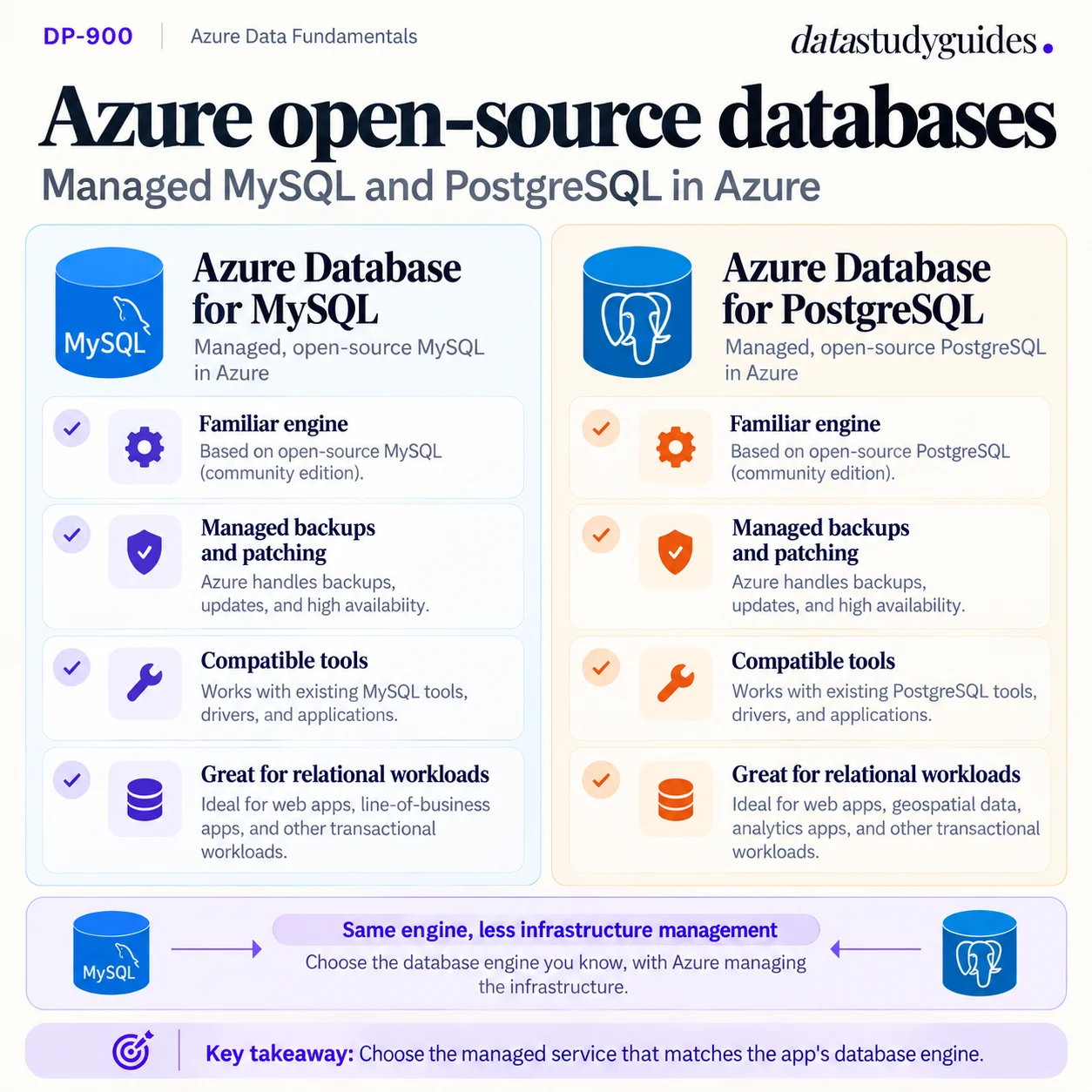
Both services run an open source engine as managed : Microsoft handles hardware, patching and backups, and your application keeps its engine, drivers and client tools, such as pgAdmin.
Side by side
- Engine
- MySQL Community Edition
- Stores
- Relational tables
- Language
- Notable
- Built-in high availability
- Engine
- PostgreSQL
- Stores
- Relational tables plus custom types, such as geometric shapes
- Language
- SQL, with PL/pgSQL for routines
- Notable
- A curated, growing set of extensions
Two names to know
PostgreSQL is a hybrid relational-object database: it also stores custom , such as lines and circles. is the deployment option for both services, with more control over configuration and cost.
On the exam, pair MySQL Community Edition with , and relational-object, geometric data, PL/pgSQL with .
Key points
- : managed based on MySQL Community Edition
- : managed PaaS for PostgreSQL, with extensions
- PostgreSQL: hybrid relational-object, custom and geometric
- PL/pgSQL: PostgreSQL's procedural language for server-side routines
- : deployment option with more control over configuration and cost
- Managed: Microsoft handles hardware, patching and backups; your tools still work
Click an underlined term for a one-line explanation, or see them all in the glossary .
Exam trap
Match the engine the application already uses. MySQL and PostgreSQL are different engines, and PostgreSQL stores more than plain relational tables.
Sources · 1 Microsoft Learn page Show ▾
Checked on October 4, 2026. Report a problem
Go deeper on Microsoft Learn
Checked against Microsoft Learn on October 4, 2026. Report a problem with this card