DP-900 · 2.1.1 · Identify considerations for relational data on Azure
Relational data model
Identify features of relational data
A models each type as a table: rows are instances, columns are typed , keys connect the tables.
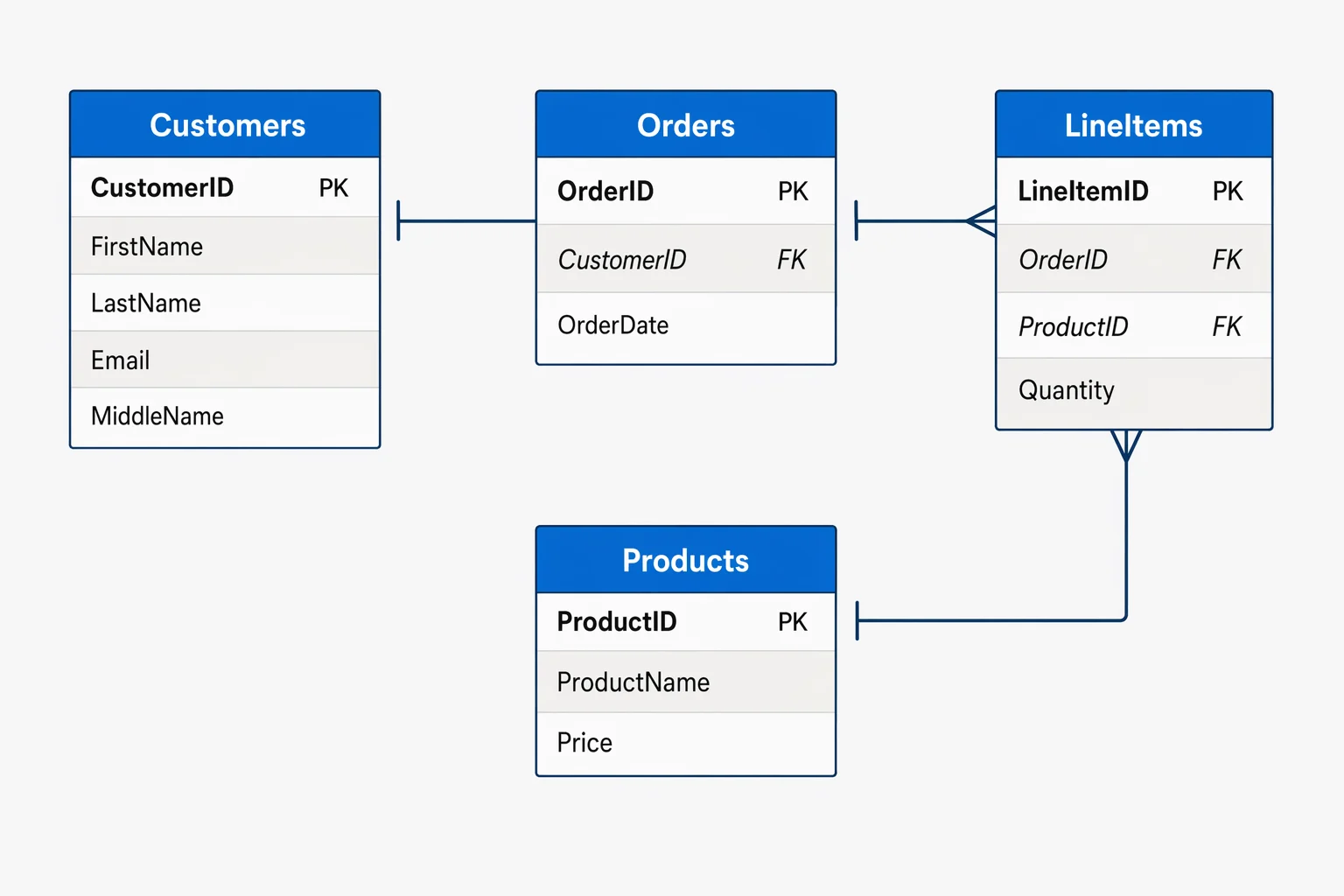
Visual: Microsoft Learn.
Each table models one type of : customers, products, orders, line items. A row is one instance, a column is one . An entity can be an object or an event, so a purchase can be a table too.
The parts of a table
Table, one type
Row
- One instance, such as one customer
Column
- One , such as the city
- One for all its values
Key
- Identifies a row and links tables
Columns, types and NULL
Every row has the same columns, and each column stores one , such as text, a number or a date. A value may be missing: a MiddleName column is for a customer without one. The column still exists, so the is unchanged.
Keys connect the tables
An order stores a CustomerID instead of the customer's name and address. The identifies the customer row; the in the order points to it.
Key points
- Table: one type of , such as customers or orders
- Row: a single instance of that entity
- Column: one , with one
- Same columns: every row shares them, a value may be
- Keys: a identifies a row, a points to it
- Entity: an object or an event, a purchase can be a table
Click an underlined term for a one-line explanation, or see them all in the glossary .
Exam trap
means the value is missing for that row. The column still exists, so the is unchanged and the data stays .
Sources · 1 Microsoft Learn page Show ▾
Checked on October 4, 2026. Report a problem
Go deeper on Microsoft Learn
Checked against Microsoft Learn on October 4, 2026. Report a problem with this card