DP-900 · 1.1.3 · Describe core data concepts
Unstructured data
Describe the features of unstructured data
has no fields or at all; the meaning sits inside the content itself.
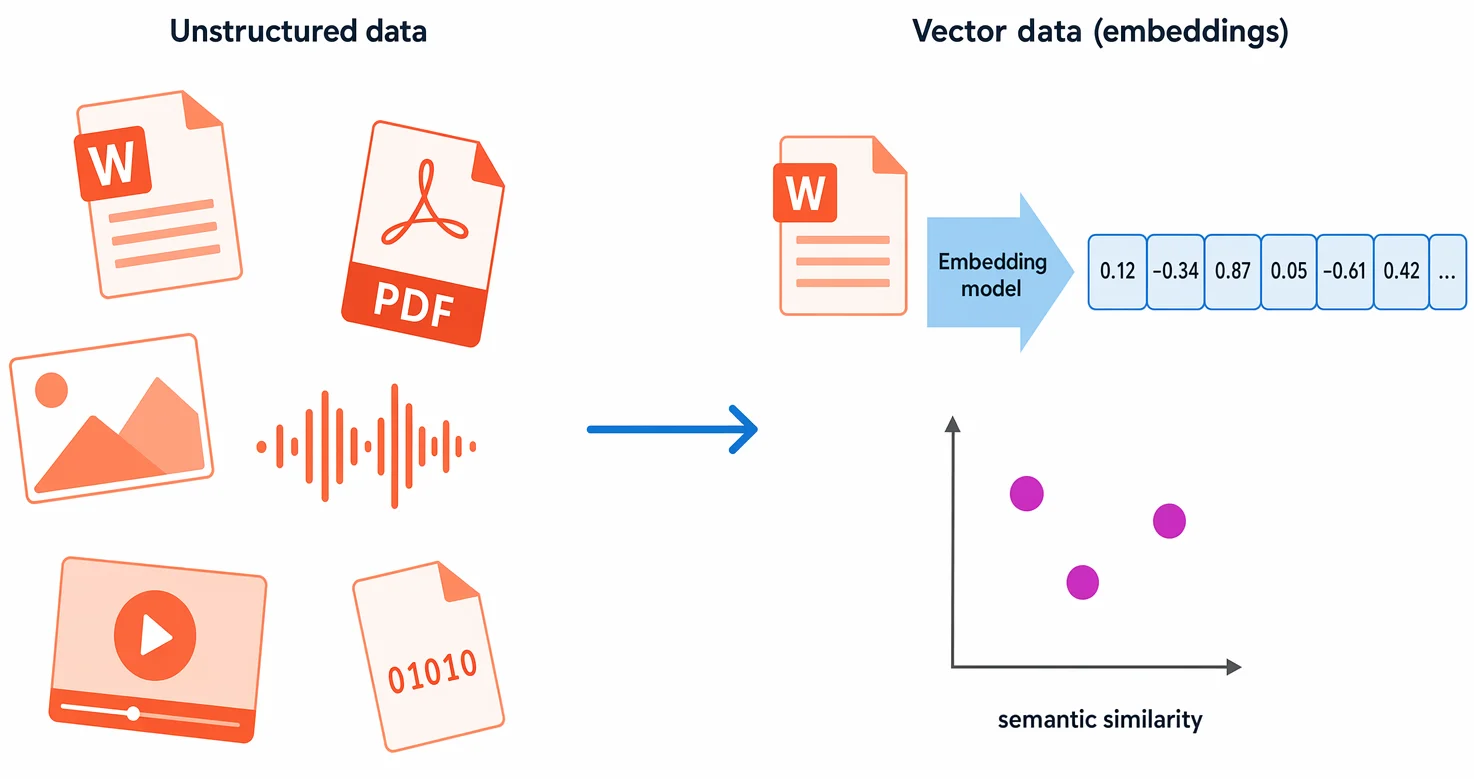
Visual: Microsoft Learn.
A photo is pixels, a recording is a waveform, a contract is free-form text. None of them has fields or a : the meaning sits inside the content itself.
One question decides the type
- The same fields in every recordTables, rows and columns
- Named fields that vary per record documents
- No fields at allDocuments, images, audio, video, binary files
Stored as files
is stored as files. Images, audio and video are raw binary data, so such files are called , binary large objects. Text or labels that AI extracts from a file can be ; the file itself stays unstructured.
Key points
- No : there are no fields or records to rely on
- Examples: documents, images, audio, video and binary files
- Storage: kept as files, often called (binary large objects)
- Binary: an application must interpret the bytes, they are not read as text
- Derived data: extracted text, labels or metadata can be
- The test: can you point at named fields in the content?
Click an underlined term for a one-line explanation, or see them all in the glossary .
Exam trap
Readable text is not automatically . A free-form document is ; a file is , although both are text.
Sources · 2 Microsoft Learn pages Show ▾
- Identify data formats (Explore core data concepts)
- Explore file storage (Explore core data concepts)
Checked on October 4, 2026. Report a problem
Go deeper on Microsoft Learn
- Identify data formats (Explore core data concepts)
- Explore file storage (Explore core data concepts)
Checked against Microsoft Learn on October 4, 2026. Report a problem with this card