AI-200 · 4.1.2 · Secure, monitor, and troubleshoot Azure solutions
App Configuration
Store and retrieve app configuration information by using Azure App Configuration
Store labeled configuration and centrally, refresh them deliberately, and keep secret values in behind references.
Centralize settings, not secrets
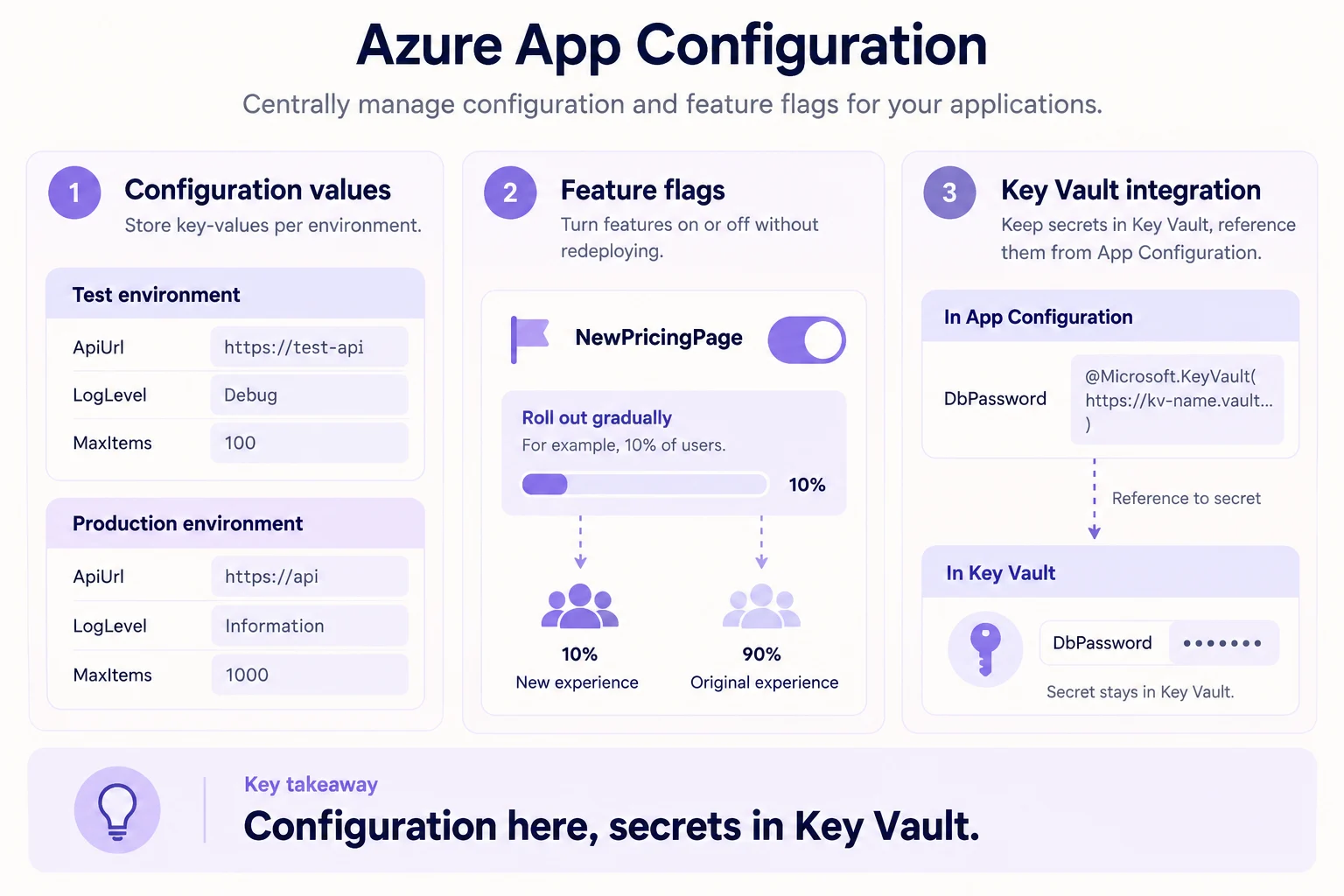
stores ordinary settings as key-values. Labels let the same key have different values for environments such as Test and Production.
change application behavior without a deployment. They can be simple on/off switches or use targeting and gradual rollout.
Refresh deliberately
Use a when several settings should change together: update the values first, change the sentinel last, and let the application refresh when it detects that one key.
Secrets stay in . App Configuration stores only a reference URI, so the application's identity needs permission to read App Configuration and the referenced Key Vault secret.
The Python provider can also refresh feature flags when refresh is enabled and the application calls config.refresh().
Key points
- Key-value: key, optional label, value, content type; keys are case-sensitive
- Labels: Test or Production variants, chosen with `SettingSelector(key_filter=..., label_filter=...)`
- Refresh: call `config.refresh()`, watch one via `refresh_on`
- : on, off or gradual rollout, loaded with `feature_flag_enabled=True`
Click an underlined term for a one-line explanation, or see them all in the glossary .
Exam trap
A stores only a URI, so the app's identity needs access to both and .
Sources · 4 Microsoft Learn pages Show ▾
- Understand the Azure App Configuration key-value store
- Azure App Configuration provider client library for Python
- Understand feature management using Azure App Configuration
- Tutorial: Use Key Vault references in an ASP.NET Core app
Checked on October 4, 2026. Report a problem
Go deeper on Microsoft Learn
- Understand the Azure App Configuration key-value store
- Azure App Configuration provider client library for Python
- Understand feature management using Azure App Configuration
- Tutorial: Use Key Vault references in an ASP.NET Core app
Checked against Microsoft Learn on October 4, 2026. Report a problem with this card