AI-200 · 3.2.1 · Connect to and consume Azure services
Functions triggers and bindings
Build serverless APIs, including implementing triggers and bindings
One trigger starts each Azure Function; bring data in or send it out, while SDK clients handle interactions that need more control.
Trigger starts, bindings connect
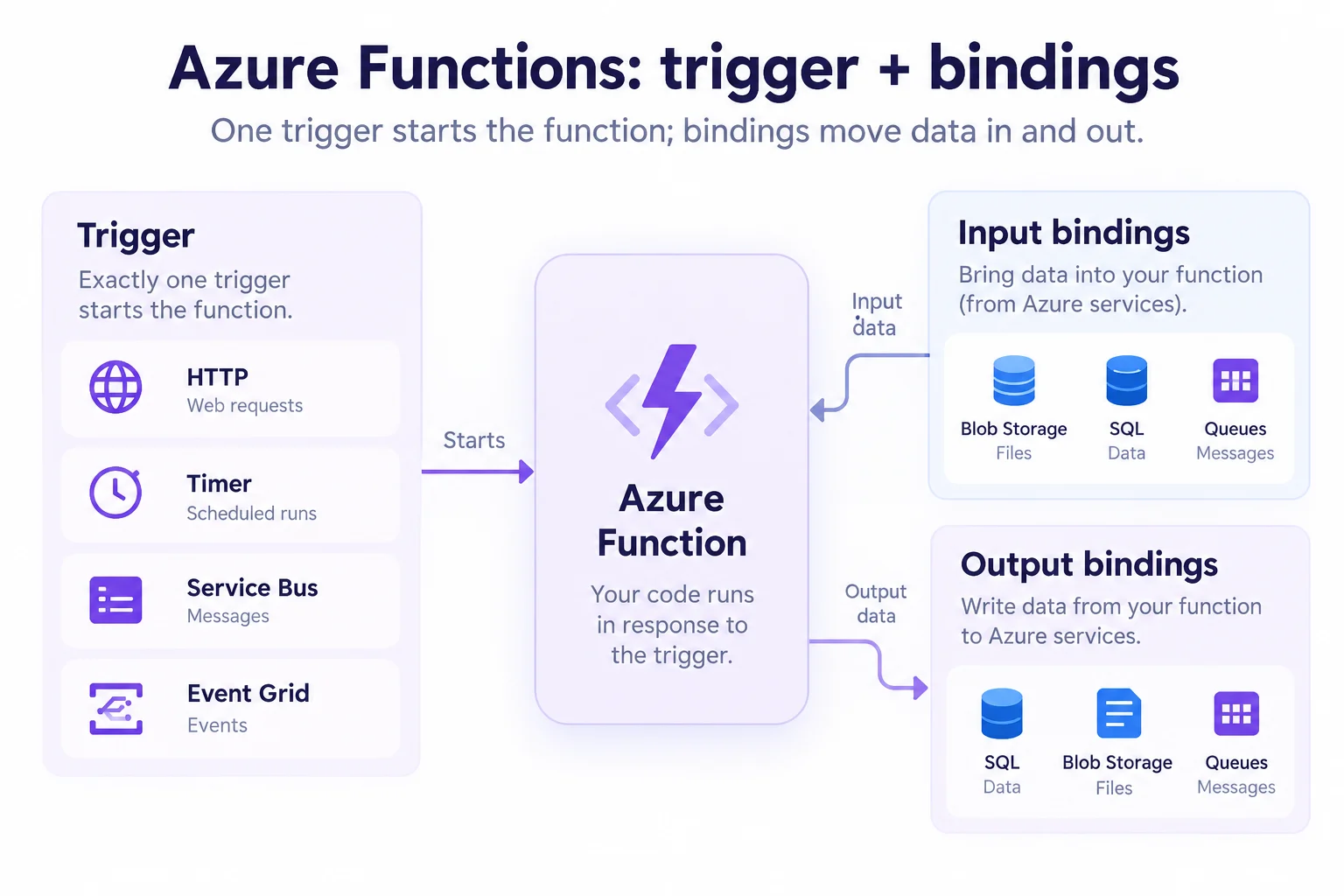
Every function has exactly one trigger. move data in or out without requiring full SDK plumbing. Not every service supports every direction, so choose the binding type the integration actually provides.
Build an HTTP API
@app.route(route="orders/{order_id}", methods=["POST"])
@app.service_bus_queue_output(
    arg_name="msg", queue_name="orders-out", connection="SB_CONN"
)
def submit(req: func.HttpRequest, msg: func.Out[str]):
    order_id = req.route_params["order_id"]
    msg.set(order_id)
    return func.HttpResponse("queued", status_code=202)
Route values are in req.route_params; query-string values are in req.params.
Know the HTTP authorization levels
Anonymous needs no Functions key. Function is the default and accepts a function or host key. Admin requires the master key. Keys can be sent in code or x-functions-key, and local Core Tools do not enforce them.
Move long work off the request
An HTTP-triggered function must answer within 230 seconds. For longer work, return 202 Accepted with a status location and queue the processing for another function.
Key points
- One trigger: every function starts from exactly one event source
- : declarative input or output links; supported directions differ by service
- Python v2: decorators declare routes, triggers, and bindings
- Route values: `req.route_params`; query string values: `req.params`
- HTTP auth: function is default; admin requires the master key
- Long HTTP work: return 202 and process asynchronously before 230 seconds
Click an underlined term for a one-line explanation, or see them all in the glossary .
Exam trap
Route values are not function arguments. In the Python v2 model, read them from `req.route_params` and query-string values from `req.params`.
Sources · 3 Microsoft Learn pages Show ▾
- Triggers and bindings in Azure Functions
- Python developer reference for Azure Functions
- Azure Functions HTTP trigger
Checked on October 4, 2026. Report a problem
Go deeper on Microsoft Learn
- Triggers and bindings in Azure Functions
- Python developer reference for Azure Functions
- Azure Functions HTTP trigger
Checked against Microsoft Learn on October 4, 2026. Report a problem with this card