AI-200 · 2.2.3 · Develop AI solutions by using Azure data management services
pgvector index tuning
Implement indexing strategies, including optimizing query latency and reducing pgvector compute overhead
Choose exact search, , or based on recall and latency, then tune query-time settings and verify the plan.
Pick the search strategy
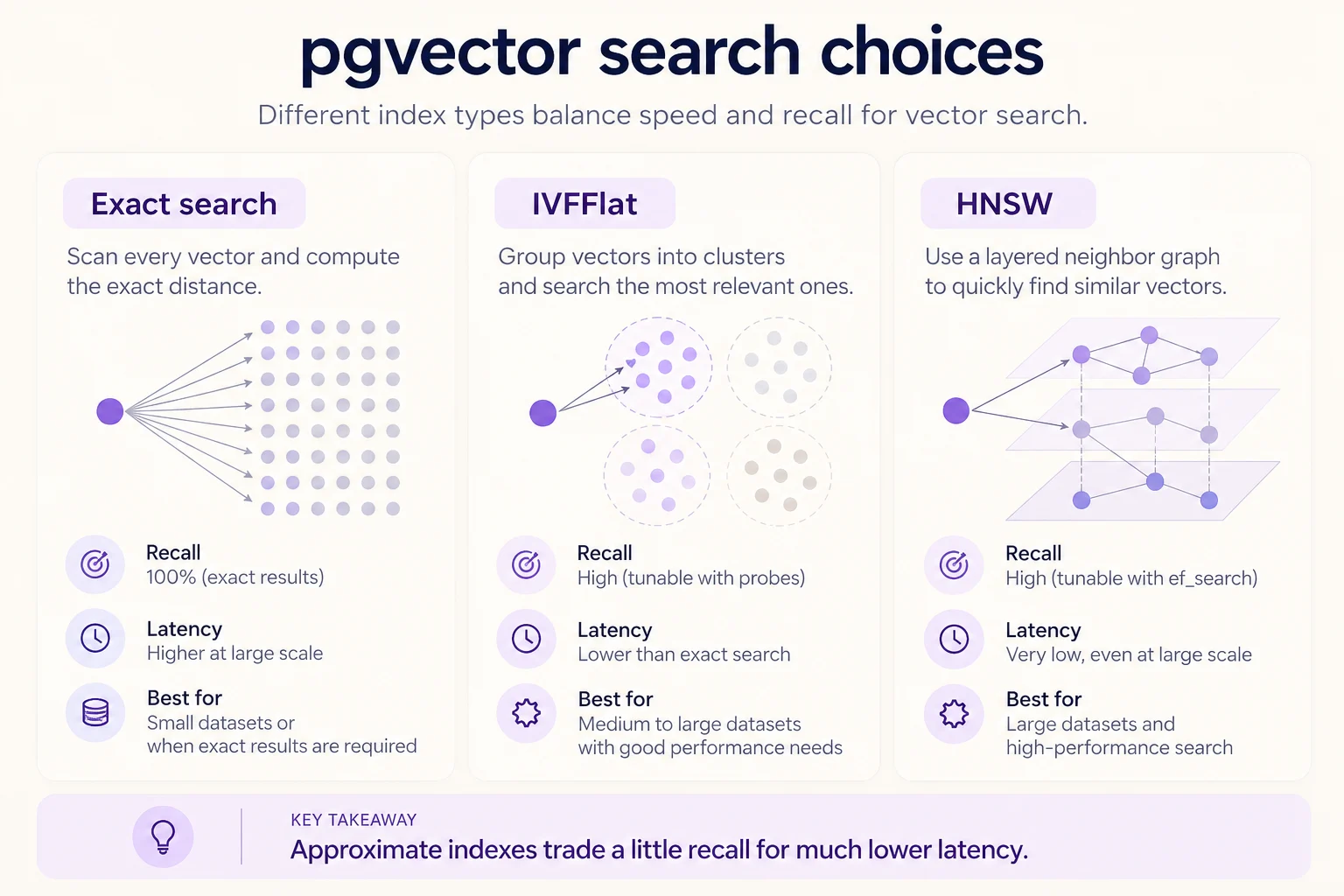
Without a vector index, PostgreSQL scans all vectors and returns exact nearest neighbors. and are approximate indexes: they trade some recall for much lower latency.
Tune recall at query time
IVFFlat searches a chosen number of clusters through ivfflat.probes. HNSW explores more graph candidates through hnsw.ef_search. Raising either setting usually improves recall and increases latency.
Your query operator must match the index . For example, cosine distance uses <=> with vector_cosine_ops; a mismatch can leave the optimizer with a sequential scan.
Use EXPLAIN (ANALYZE, BUFFERS) to confirm which index and workers the query actually uses.
Key points
- : `vector_cosine_ops` with `<=>`, `vector_l2_ops` with `<->`, `vector_ip_ops` with `<#>`
- Recall: raise `.probes` or `.ef_search`; costs latency, `SET LOCAL` per transaction
- : helps only queries with a matching WHERE; same for partitions
- EXPLAIN: `EXPLAIN (ANALYZE, BUFFERS)` shows index, parallel workers, partition pruning
Click an underlined term for a one-line explanation, or see them all in the glossary .
Exam trap
A mismatched operator is not an error: `ORDER BY <->` against a `vector_cosine_ops` index silently runs a sequential scan.
Sources · 2 Microsoft Learn pages Show ▾
- Optimize performance when using pgvector (Azure Database for PostgreSQL)
- Perform fast vector similarity search (Implement vector search with Azure Database for PostgreSQL)
Checked on October 4, 2026. Report a problem
Go deeper on Microsoft Learn
- Optimize performance when using pgvector (Azure Database for PostgreSQL)
- Perform fast vector similarity search (Implement vector search with Azure Database for PostgreSQL)
Checked against Microsoft Learn on October 4, 2026. Report a problem with this card