AI-200 · 2.3.2 · Develop AI solutions by using Azure data management services
Redis vector search
Implement vector indexing to enable similarity search
Enable at cache creation, define a matching , choose FLAT or , and query nearest neighbors with .
Build the vector index
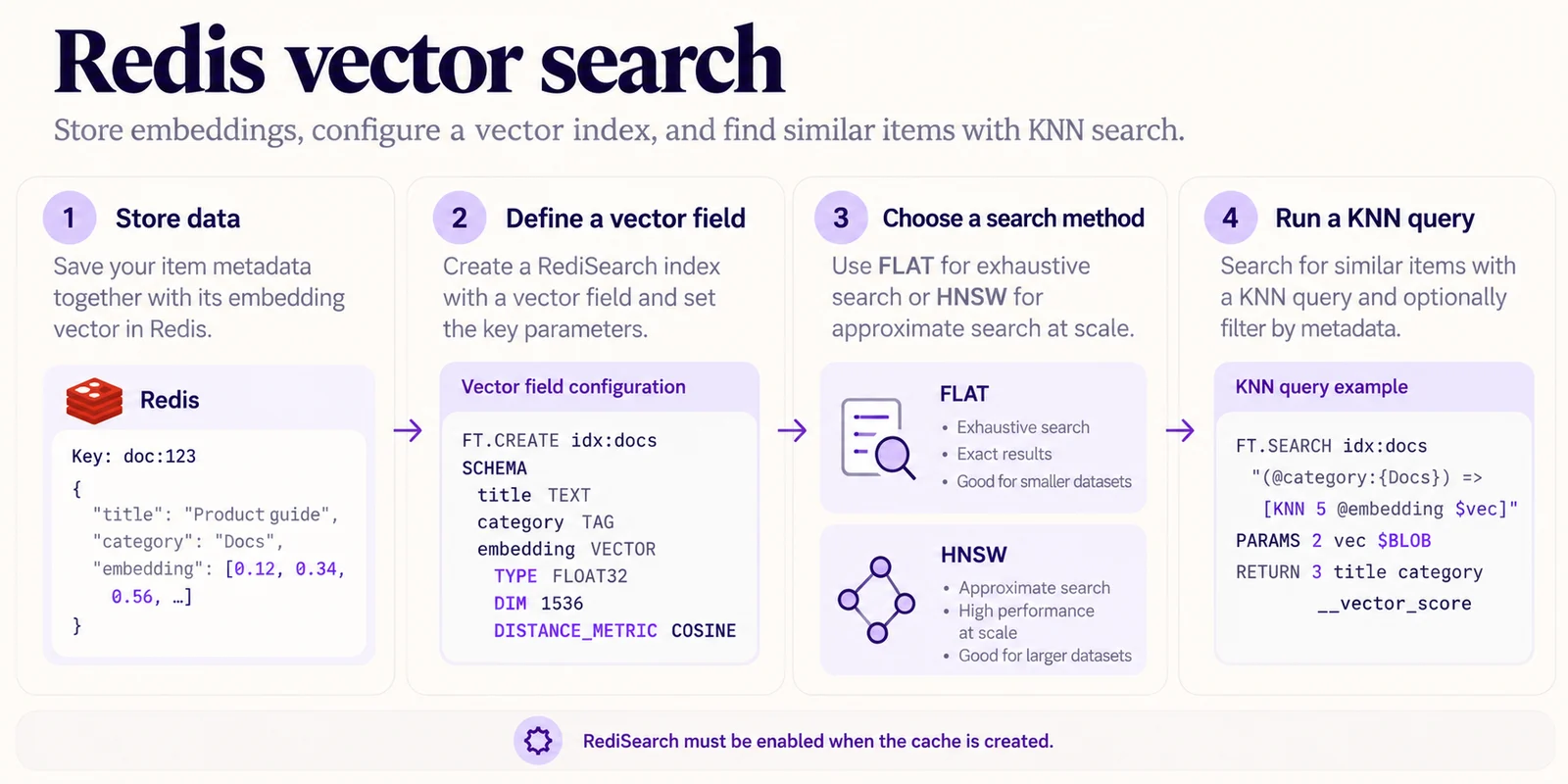
Azure Managed Redis comes from the module. Enable the module when you create the cache, then store beside the metadata you want to filter.
A declares the storage type, dimensions and distance metric. Those settings must match the embedding model used for both stored and query vectors.
Choose FLAT or HNSW
FLAT performs an exhaustive search and fits smaller sets. is approximate and is designed for lower latency at scale.
A ranks the closest vectors and can combine that ranking with . In Azure Managed Redis, plan the required modules and clustering settings before creation because modules cannot be added to an existing cache later.
Key points
- : needs and NoEviction; not on Flash Optimized
- Storage: hash (vector as float32 bytes) or JSON document, next to metadata
- : FLAT or , type, dimensions, metric (L2, COSINE, IP)
- : K closest vectors, vector passed as bytes, optional
Click an underlined term for a one-line explanation, or see them all in the glossary .
Exam trap
Planning to add later: modules are chosen at creation, so a cache made without it must be replaced.
Sources · 4 Microsoft Learn pages Show ▾
- About vector embeddings and vector search in Azure Managed Redis
- Using Redis modules with Azure Managed Redis
- Azure Managed Redis architecture
- Tutorial: Build agent memory with Azure Managed Redis
Checked on October 4, 2026. Report a problem
Go deeper on Microsoft Learn
- About vector embeddings and vector search in Azure Managed Redis
- Using Redis modules with Azure Managed Redis
- Azure Managed Redis architecture
- Tutorial: Build agent memory with Azure Managed Redis
Checked against Microsoft Learn on October 4, 2026. Report a problem with this card