DP-600 · 2.1.4 · Prepare data
Choose a Fabric store
Choose between different data stores
Choose the Fabric data store by workload, data shape, preferred engine, and whether transactional guarantees are required.
The core idea
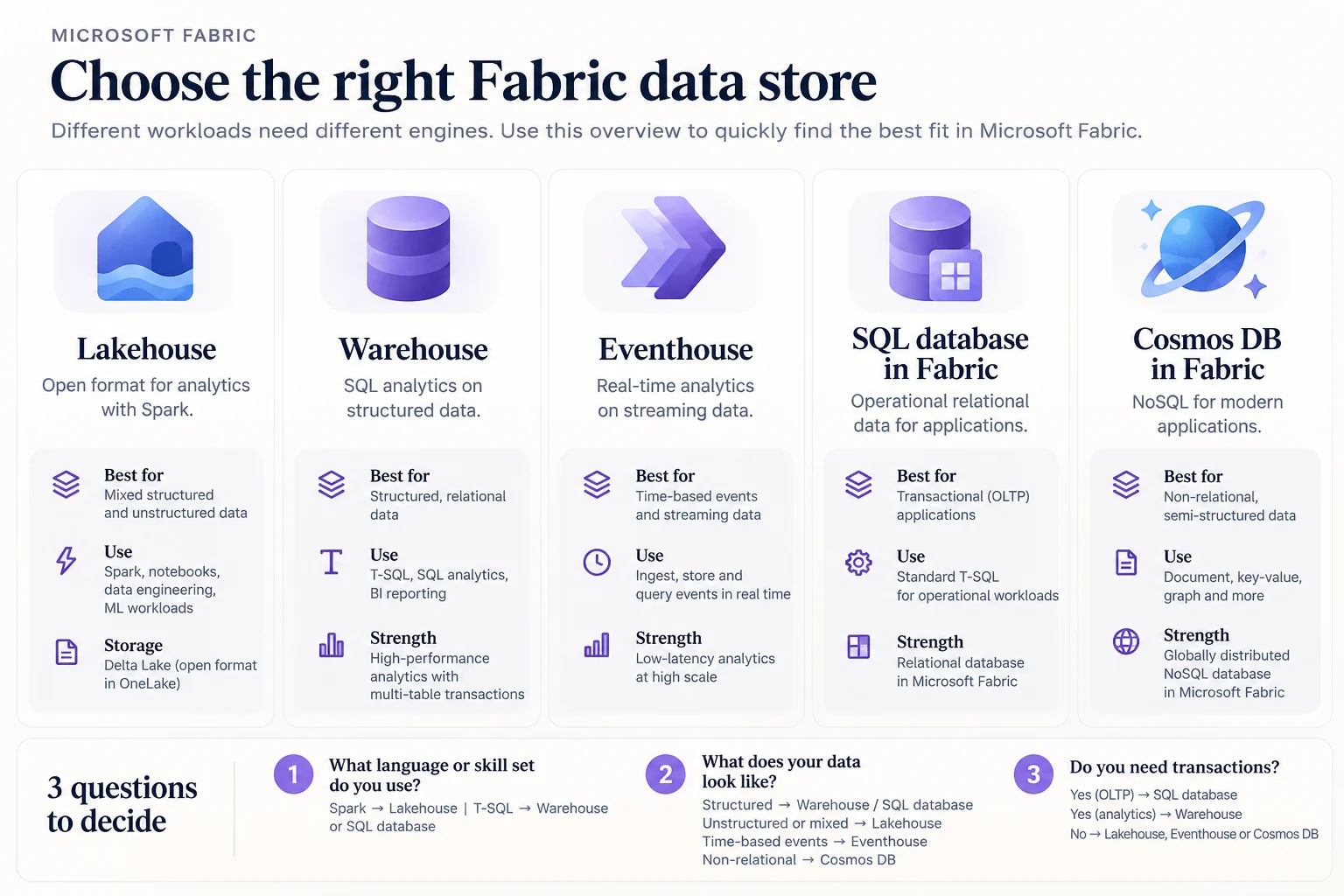
Fabric data stores are optimized for different jobs. A is Spark-first and handles mixed or unstructured data. A is T-SQL-first, relational, and supports multi-table transactions.
targets streaming and time-series analytics. SQL database in Fabric supports operational relational workloads, while Cosmos DB in Fabric fits NoSQL application data.
For lakehouse versus warehouse, focus on language, data shape, and transaction requirements.
Key points
- : Spark and mixed structured or unstructured data
- : analytics with multi-table transactions
- : high-volume time-based and streaming analytics
- Operational: SQL database for relational OLTP, Cosmos DB for NoSQL
Click an underlined term for a one-line explanation, or see them all in the glossary .
Exam trap
The of a speaks , but it is read-only. A team that must insert, update or delete with T-SQL, or needs multi-table transactions, needs a .
Sources · 3 Microsoft Learn pages Show ▾
- Fabric decision guide: choose a data store
- Warehouse and Lakehouse: a decision guide
- What is the SQL analytics endpoint for a lakehouse?
Checked on October 4, 2026. Report a problem
Go deeper on Microsoft Learn
- Fabric decision guide: choose a data store
- Warehouse and Lakehouse: a decision guide
- What is the SQL analytics endpoint for a lakehouse?
Checked against Microsoft Learn on October 4, 2026. Report a problem with this card