DP-600 · 2.2.6 · Prepare data
Join or merge data
Merge or join data
Choose the join type by which unmatched rows must survive; use MERGE when the target table itself must be inserted, updated, or deleted.
The core idea
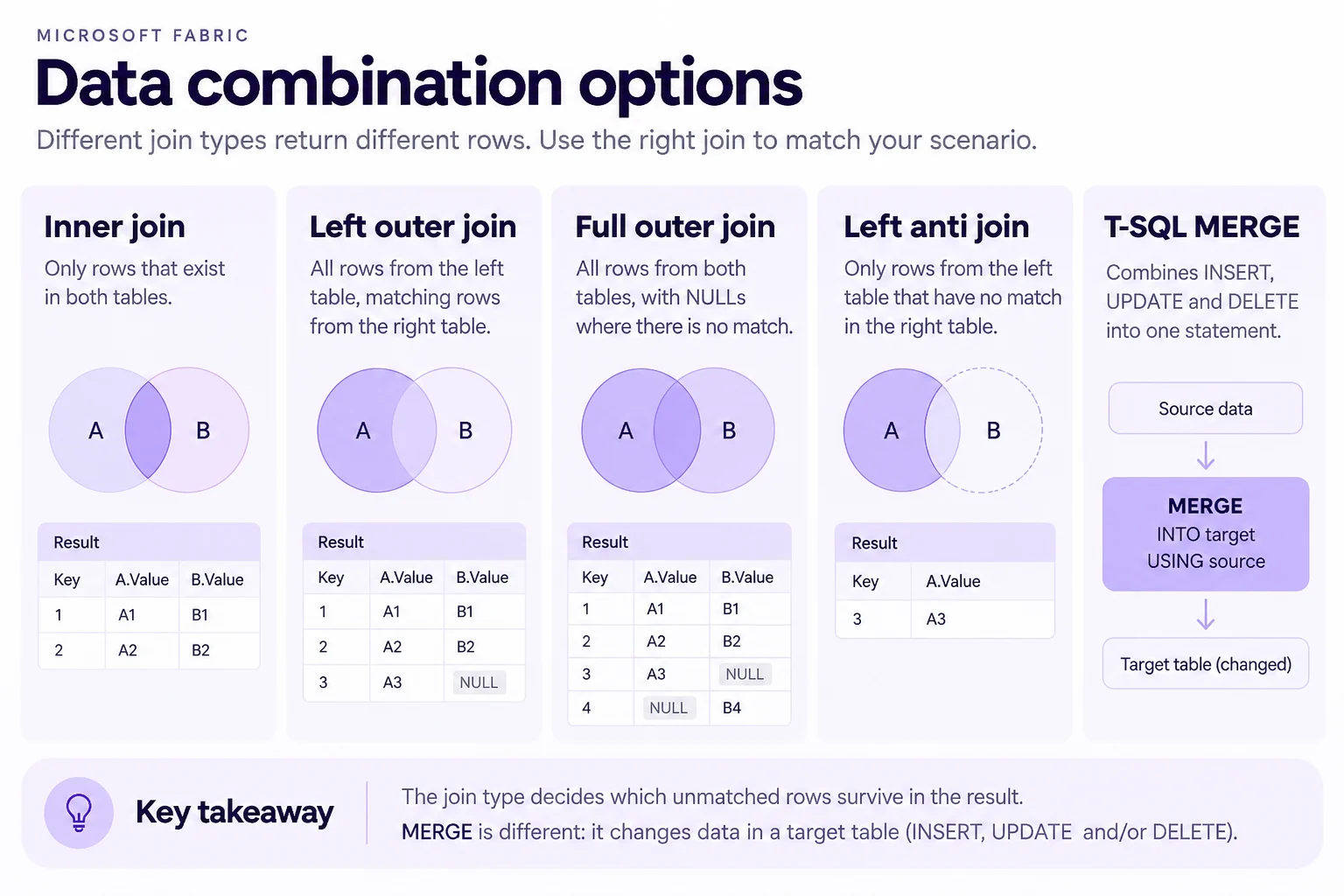
A join combines columns from related tables. The join kind decides which unmatched rows remain.
Inner keeps only matches. keeps every left row. keeps both sides. returns only left rows with no match.
MERGE is different because it changes a target table. On outer joins, place right-side filters in ON when unmatched left rows must survive.
Key points
- Inner: keep rows matched on both sides
- : keep every left row
- : keep every row from both sides
- MERGE: changes target rows from a source
Click an underlined term for a one-line explanation, or see them all in the glossary .
Exam trap
A WHERE filter on the right table after a can remove unmatched left rows and effectively turn it into an .
Sources · 4 Microsoft Learn pages Show ▾
- FROM clause plus JOIN, APPLY, PIVOT (T-SQL)
- MERGE (Transact-SQL)
- Merge queries overview (Power Query)
- Left anti join (Power Query)
Checked on October 4, 2026. Report a problem
Go deeper on Microsoft Learn
- FROM clause plus JOIN, APPLY, PIVOT (T-SQL)
- MERGE (Transact-SQL)
- Merge queries overview (Power Query)
- Left anti join (Power Query)
Checked against Microsoft Learn on October 4, 2026. Report a problem with this card