DP-600 · 2.1.3 · Prepare data
Ingest or access data
Ingest or access data as needed
Choose , , pipeline, dataflow, , or based on copying, freshness, transformation, and streaming needs.
The core idea
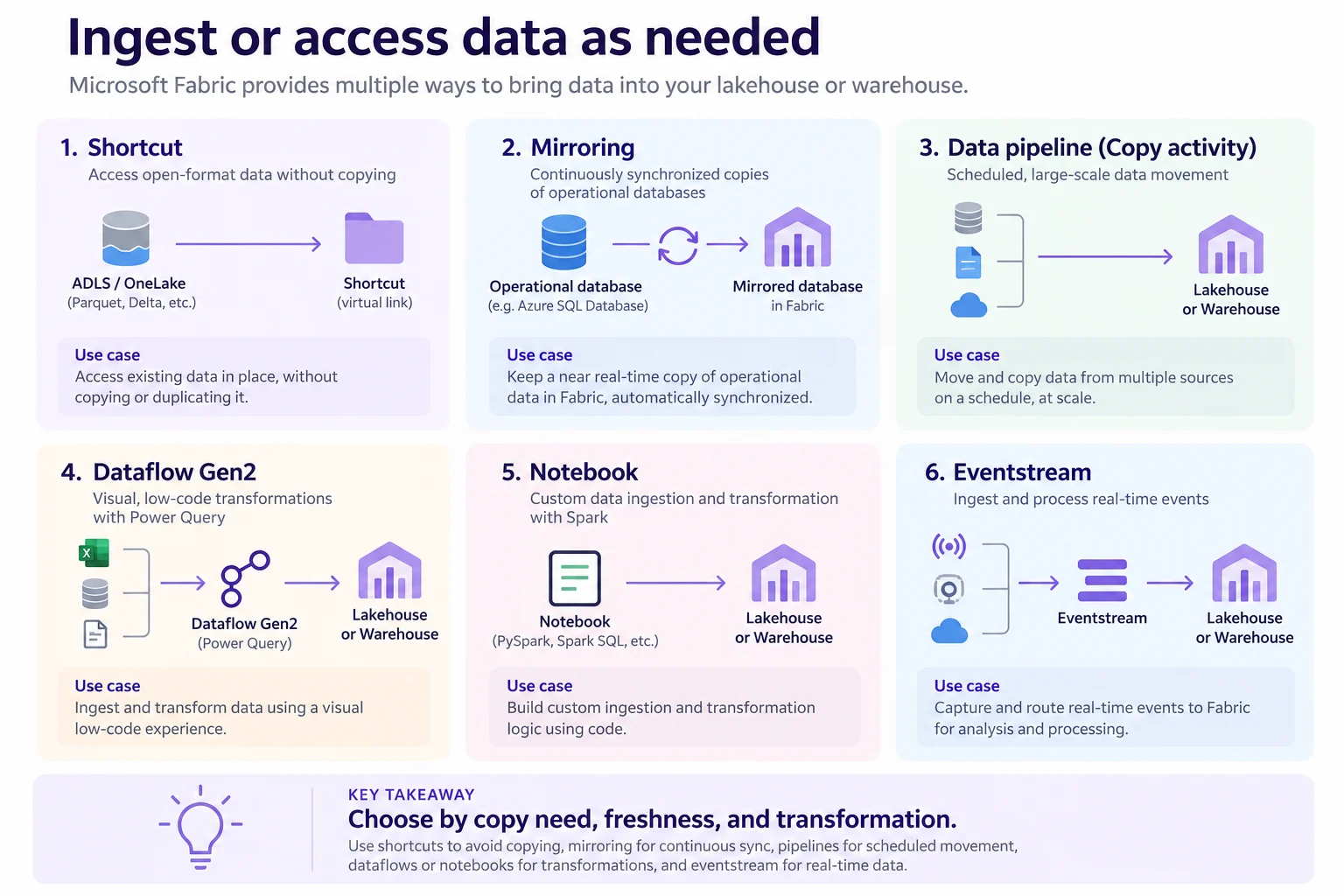
Start with three questions: must the data be copied, how fresh must it be, and how much transformation is required?
reference open-format data in place. keeps a database or catalog synchronized into Fabric. Pipelines move data on a schedule or trigger.
Use for visual Power Query transformations, for custom Spark logic, and for continuous event ingestion.
Key points
- : access open-format data without copying
- : continuously sync an operational database
- Pipeline: scheduled or triggered movement at scale
- Transform: for low-code, for custom logic
Click an underlined term for a one-line explanation, or see them all in the glossary .
Exam trap
Do not copy data by default. A or option can be better when duplication, latency, or maintenance should be minimized.
Sources · 3 Microsoft Learn pages Show ▾
- Unify data with OneLake shortcuts and mirroring
- Data ingestion options for a lakehouse
- OneLake shortcuts
Checked on October 4, 2026. Report a problem
Go deeper on Microsoft Learn
- Unify data with OneLake shortcuts and mirroring
- Data ingestion options for a lakehouse
- OneLake shortcuts
Checked against Microsoft Learn on October 4, 2026. Report a problem with this card