DP-600 · 2.2.4 · Prepare data
Denormalize for analytics
Denormalize data
Flatten related dimension attributes into fewer tables so analytical queries need fewer joins and stay simpler.
The core idea
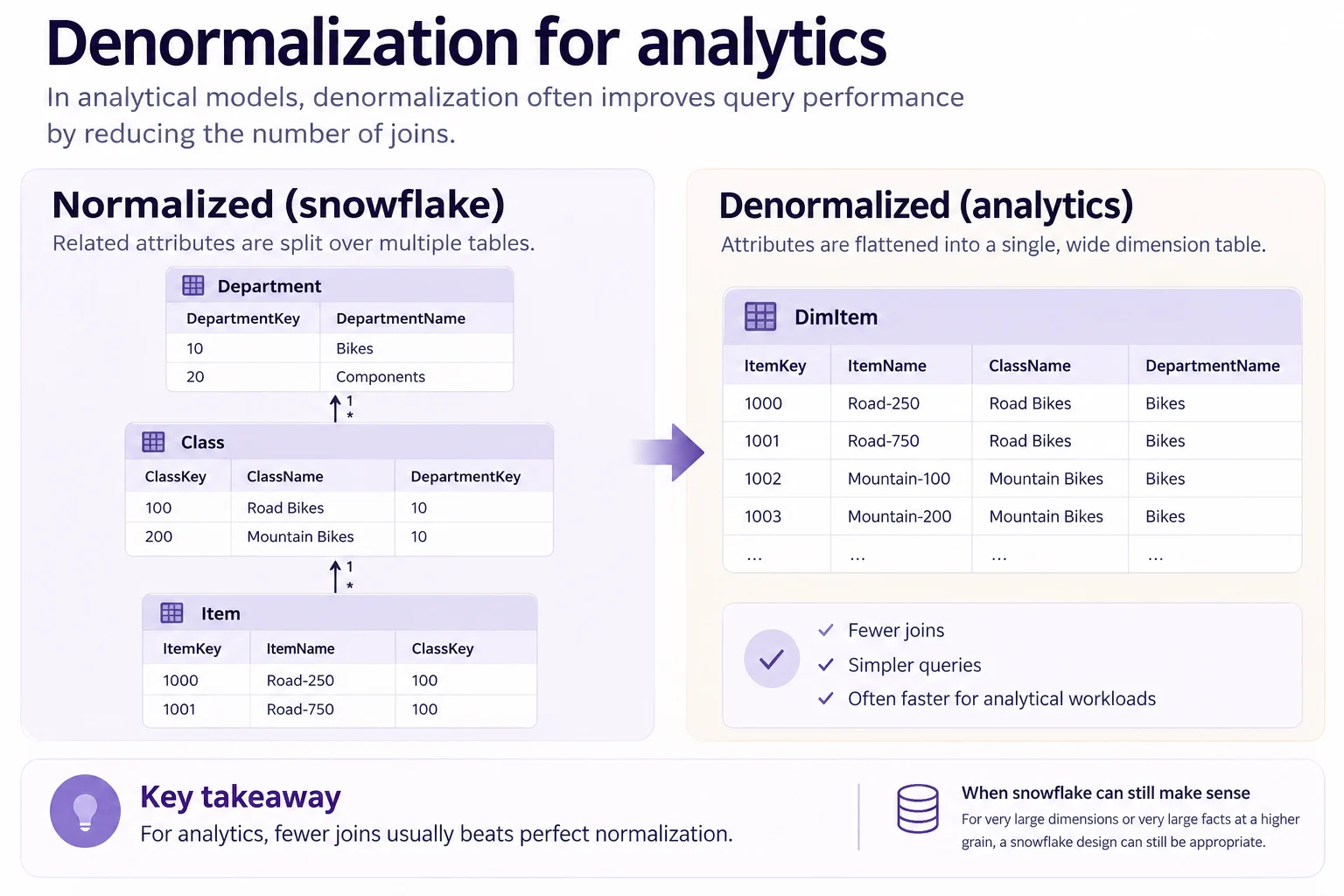
Analytical models deliberately trade some duplication for simpler and often faster queries. Flattening Department, Class, and Item into one dimension removes extra joins from every query.
Dimensions are usually good candidates because their descriptive data is small relative to .
Keep a snowflake only when there is a concrete reason, such as an extremely large dimension or facts at a higher .
Key points
- : repeat descriptive values to reduce joins
- Dimensions: usually flatten hierarchy levels into one table
- Snowflake: keep only when scale or justifies it
- : one-table hierarchies are easier to use
Click an underlined term for a one-line explanation, or see them all in the glossary .
Exam trap
Do not normalize analytics models by default. Extra joins can make models harder to use and slower without adding analytical value.
Sources · 3 Microsoft Learn pages Show ▾
- Modeling dimension tables in Warehouse (Microsoft Fabric)
- Describe dimensional schema types (Design dimensional models for analytics in Microsoft Fabric)
- Merge queries overview (Power Query)
Checked on October 4, 2026. Report a problem
Go deeper on Microsoft Learn
- Modeling dimension tables in Warehouse (Microsoft Fabric)
- Describe dimensional schema types (Design dimensional models for analytics in Microsoft Fabric)
- Merge queries overview (Power Query)
Checked against Microsoft Learn on October 4, 2026. Report a problem with this card