DP-600 · 2.2.1 · Prepare data
Reusable T-SQL objects
Create views, functions, and stored procedures
Use a view for a reusable query, an inline for a parameterized query, and a for multi-step data-changing logic.
The core idea
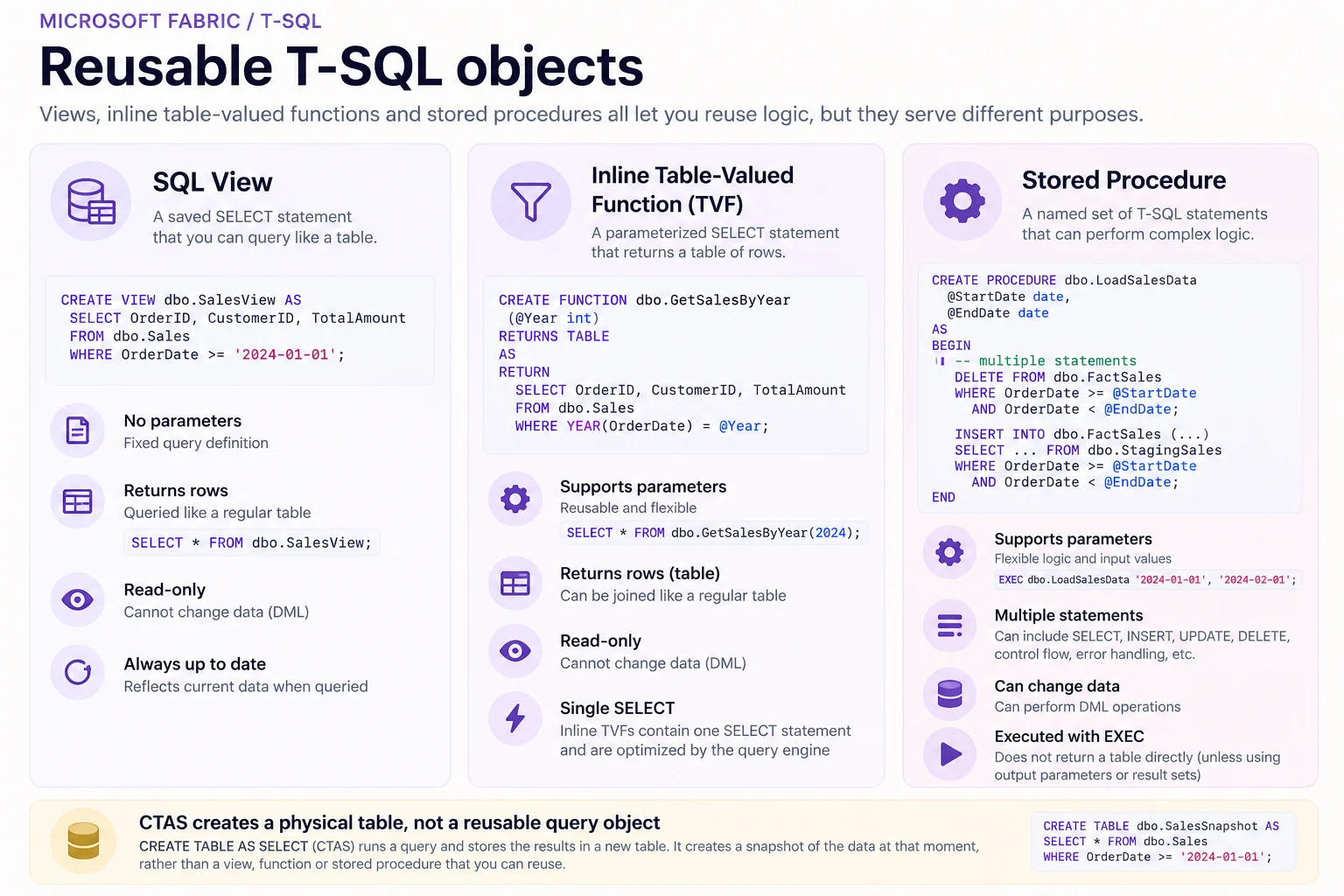
Choose the object by what the logic must do. A view is a saved SELECT with no parameters. An adds parameters while still returning rows from one SELECT.
A can run multiple statements and change data, so it suits repeatable load steps.
is different: it materializes a new table from a query result instead of storing reusable query logic.
Key points
- View: saved SELECT, queried like a table
- : parameterized SELECT returning rows
- Procedure: multiple statements executed with EXEC
- : stores a physical snapshot table
Click an underlined term for a one-line explanation, or see them all in the glossary .
Exam trap
A view cannot accept parameters. Use an when reusable row-returning logic needs parameters.
Sources · 4 Microsoft Learn pages Show ▾
- T-SQL surface area in Fabric Data Warehouse (Microsoft Fabric)
- Query and transform data (Get started with data warehouses in Microsoft Fabric)
- CREATE FUNCTION (Microsoft Fabric, Azure Synapse Analytics)
- Data Warehouse Tutorial: Transform data with a stored procedure in a warehouse (Microsoft Fabric)
Checked on October 4, 2026. Report a problem
Go deeper on Microsoft Learn
- T-SQL surface area in Fabric Data Warehouse (Microsoft Fabric)
- Query and transform data (Get started with data warehouses in Microsoft Fabric)
- CREATE FUNCTION (Microsoft Fabric, Azure Synapse Analytics)
- Data Warehouse Tutorial: Transform data with a stored procedure in a warehouse (Microsoft Fabric)
Checked against Microsoft Learn on October 4, 2026. Report a problem with this card