DP-750 · 3.1.3 · Prepare and process data
Batch or streaming
Choose a data loading method, including batch and streaming
Choose batch for bounded periodic work and streaming when data must be processed incrementally as it arrives.
See streaming as a flow
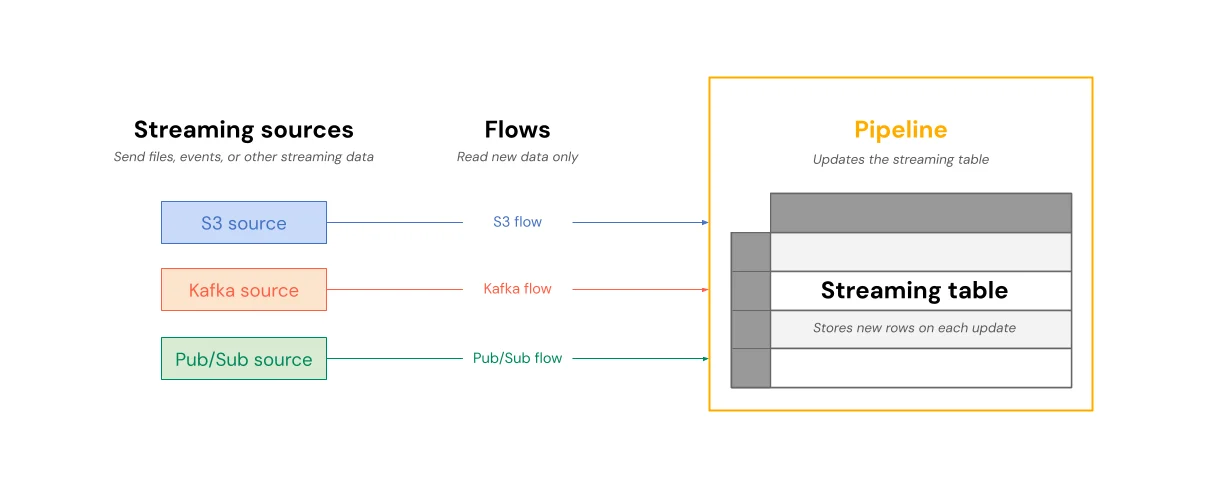
The product model makes the streaming choice concrete: new records are read incrementally by flows and appended to a streaming table. Keep the comparison diagram below for the batch-versus-streaming decision itself.
Let latency choose the model
Batch
- Data
- Bounded
- Execution
- Scheduled
- Latency
- Higher
- State
- Usually simple
Streaming
- Data
- Unbounded
- Execution
- Incremental
- Latency
- Lower
- State
- Checkpoints and state
Batch fits bounded datasets and scheduled refresh windows. Streaming fits data that must be processed as it arrives.
Streaming needs recoverable state
- 1New recordsArrive continuously
- 2CheckpointStores progress and state
- 3WatermarkBounds late-data state
- 4OutputIncrementally updated
Checkpoints support restart recovery. Watermarks help bound state for late-arriving events.
Do not stream by habit
If the business only needs a daily refresh, batch is usually easier to operate and troubleshoot. Choose the lowest-complexity architecture that meets freshness requirements.
Key points
- Batch: Processes a bounded dataset on a schedule
- Streaming: Processes new data incrementally
- Latency: Lower latency favors streaming
- Cost: Batch can be simpler when near-real-time is unnecessary
Exam trap
Streaming is not automatically better; it adds state, checkpoint, and operational considerations.
Sources · 1 Microsoft Learn page Show ▾
Checked on October 4, 2026. Report a problem
Go deeper on Microsoft Learn
Checked against Microsoft Learn on October 4, 2026. Report a problem with this card