DP-750 · 4.3.6 · Deploy and maintain data pipelines and workloads
Deploy with REST APIs
Deploy a bundle by using REST APIs
Automate Databricks resource deployment through authenticated REST calls that create or update the jobs, pipelines, and objects represented by project configuration.
Put API deployment in the automation flow
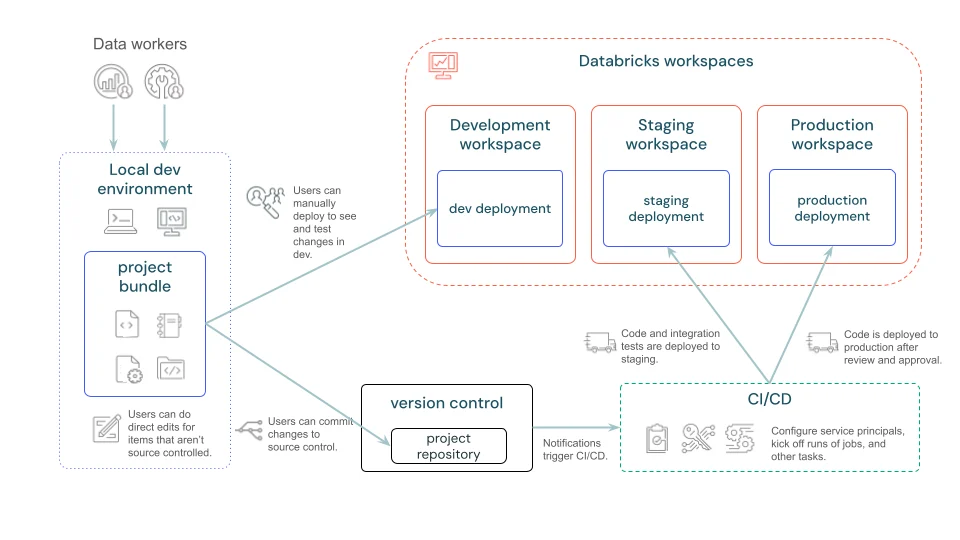
REST API deployment is usually one automation mechanism inside a broader CI/CD path. This architecture shows that path; the diagrams below focus on request sequencing, authentication, and deployment state.
Understand the lower-level path
- 1Automation identityAuthenticate with OAuth
- 2API endpointAddress the workspace or account resource
- 3Desired stateDecide create or update
- 4REST requestSend resource configuration
- 5VerifyRead back resulting state
Direct REST deployment gives lower-level lifecycle control than a bundle deployment.
Bundles versus direct REST
Bundle
- Desired state
- Declarative project
- Create/update
- Managed by bundle tooling
- Best fit
- Repeatable project deployment
Direct REST
- Desired state
- Your automation logic
- Create/update
- You decide
- Best fit
- Custom lifecycle control
Direct API automation must converge resources on the intended state instead of blindly creating duplicates.
Use the correct scope
Workspace resources such as jobs use workspace APIs. Account-level objects use account APIs. Authenticate unattended automation with a dedicated service principal.
Key points
- REST endpoint: Use the correct workspace or account API
- OAuth: Prefer service-principal authentication for unattended deployment
- Resource mapping: Bundle resource fields mirror corresponding API objects
- Idempotence: Use create or update logic that converges on desired state
Exam trap
REST automation operates on Databricks resources directly; it must reproduce the desired-state and update logic that the CLI normally manages.
Sources · 2 Microsoft Learn pages Show ▾
Checked on October 4, 2026. Report a problem
Go deeper on Microsoft Learn
Checked against Microsoft Learn on October 4, 2026. Report a problem with this card