DP-750 · 4.2.1 · Deploy and maintain data pipelines and workloads
Create Lakeflow Job
Create a job, including setup and configuration
Create a job as an orchestrated collection of tasks, compute, parameters, dependencies, and operational settings.
See the job as an operational graph
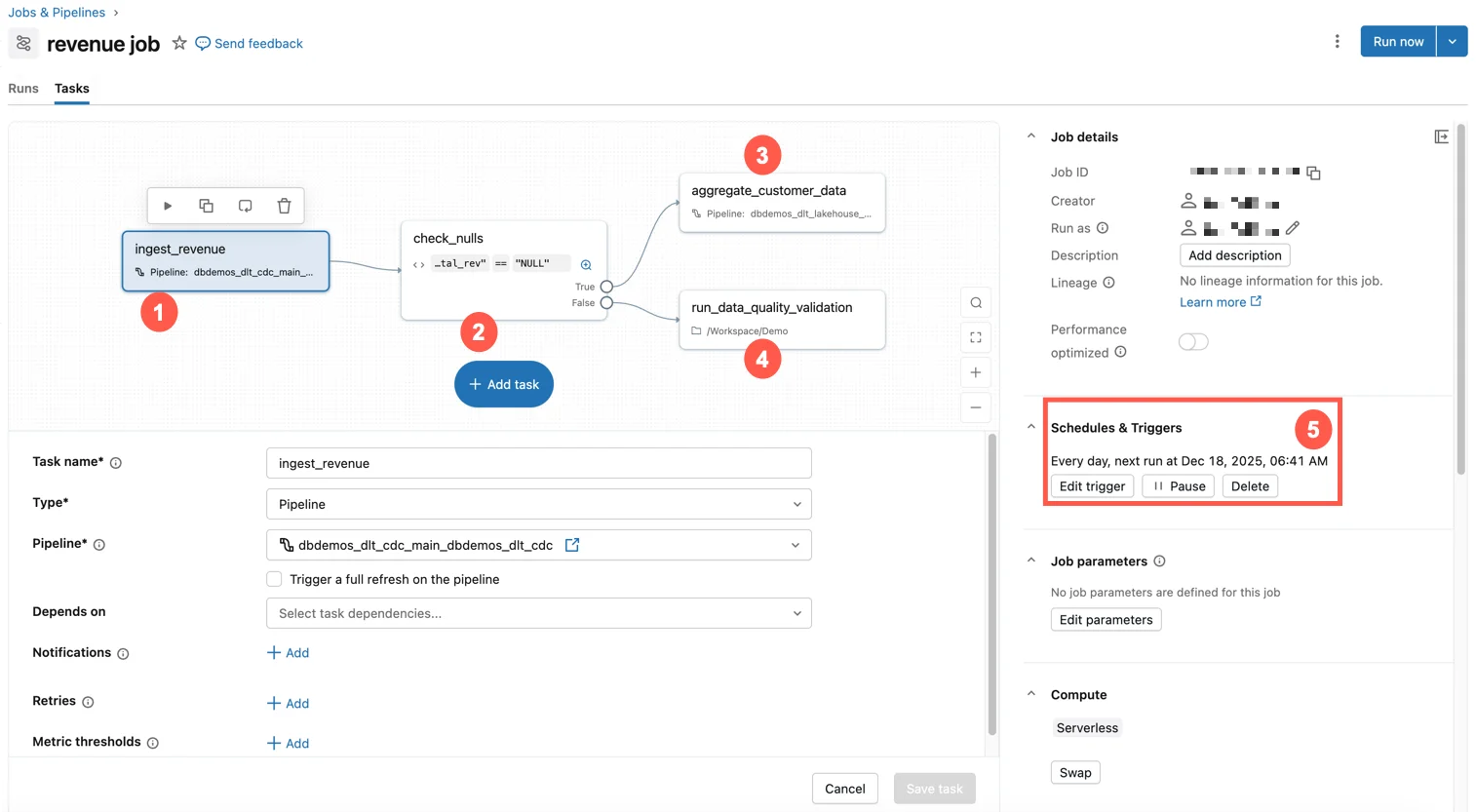
A Lakeflow Job is the operational container for tasks, dependencies, parameters, compute, triggers, notifications, and concurrency settings.
Keep task boundaries meaningful
- 1Job parametersShared runtime inputs
- 2Task AOne executable unit
- 3DependencyControls readiness
- 4Task BConsumes upstream output
- 5TriggerStarts the run
Task boundaries make recovery and monitoring visible instead of hiding the workflow inside one notebook.
Put operational controls at job scope
- When the run startsTrigger
- Shared runtime valueJob parameter
- What executesTask
- Who gets notifiedJob notification
Centralize environment-specific values rather than duplicating them across tasks.
Key points
- Job: Top-level workflow definition
- Task: Executable unit inside the job
- Compute: Serverless or configured compute per workload
- Parameters: Reusable values supplied at job or task level
Exam trap
Do not put environment-specific values directly into every task when job parameters can centralize them.
Sources · 2 Microsoft Learn pages Show ▾
Checked on October 4, 2026. Report a problem
Go deeper on Microsoft Learn
Checked against Microsoft Learn on October 4, 2026. Report a problem with this card