PL-300 · 4.2.3 · Manage and secure Power BI
Configure access to semantic models
Configure access to semantic models
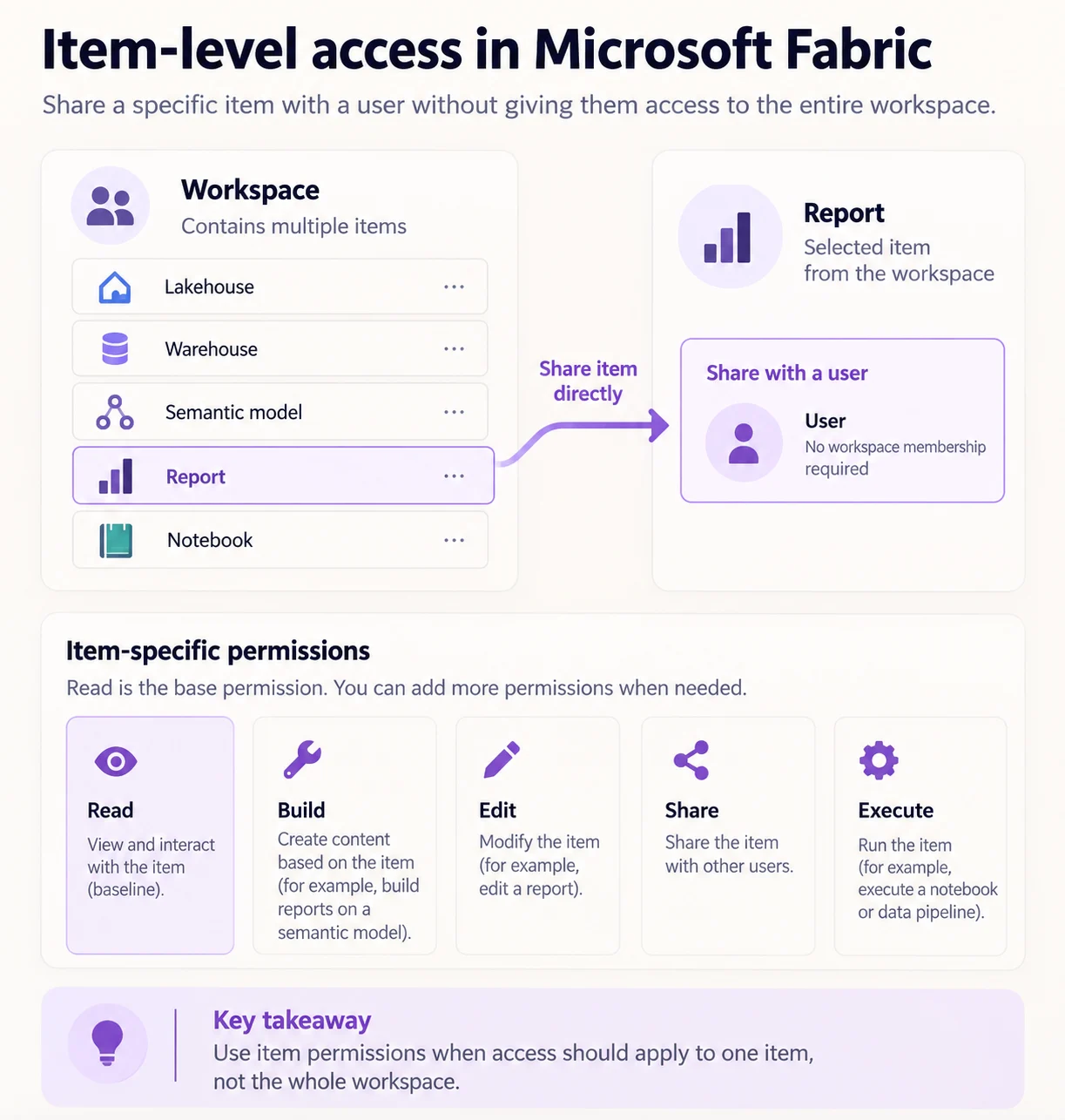
permissions separate reading, building, resharing, and writing from membership.
Semantic model permissions control reuse
is the important permission when a user should create new content from an existing . It does not control which rows that user can see; row visibility belongs to .
can already grant some of these permissions, and additional access can be managed separately on the semantic model.
Permission versus data visibility
Read lets someone consume content that uses the semantic model. Build lets them create new content from it. lets them pass access onward, while Write allows model changes.
None of these replaces row-level security. Build decides whether the model can be reused; RLS decides which rows an authorized user can see.
Exam clue: reuse the model for a new report = Build. Restrict visible rows = RLS.
Key points
- Read: consume reports using the model
- : create new content from the model
- : grant model access onward
- Write: modify or republish the model
Click an underlined term for a one-line explanation, or see them all in the glossary .
Exam trap
controls reuse, not row visibility. Use to restrict which model rows a user can see.
Sources · 3 Microsoft Learn pages Show ▾
- Semantic model permissions
- Build permission for shared semantic models
- Manage semantic model access permissions
Checked on October 4, 2026. Report a problem
Go deeper on Microsoft Learn
- Semantic model permissions
- Build permission for shared semantic models
- Manage semantic model access permissions
Checked against Microsoft Learn on October 4, 2026. Report a problem with this card